How Dividend Stocks and Reinvested Earnings Can Help Build Long-Term Wealth

Building lasting financial security requires more than saving money in a bank account. One of the most reliable paths involves carefully selected dividend stocks combined with the disciplined practice of reinvesting earnings. This approach harnesses the power of compounding, turning modest regular income into substantial wealth over decades. By focusing on companies that share profits with shareholders and then putting those payments back to work, investors create a self-reinforcing cycle of growth that few other strategies can match for consistency and resilience.
The Foundation of Dividend Investing
Companies that distribute a portion of their profits as regular cash payments offer investors two sources of return: the income itself and potential share price appreciation. These payments provide tangible cash flow that can cushion portfolios during market downturns. Over long periods, this income stream has historically contributed a significant share of total stock market returns.
Selecting businesses with sustainable payout ratios, strong free cash flow, and a track record of maintaining or increasing distributions helps ensure reliability. Sectors such as consumer staples, utilities, and healthcare often feature firms capable of supporting these payments through economic cycles.
How Reinvested Earnings Accelerate Growth
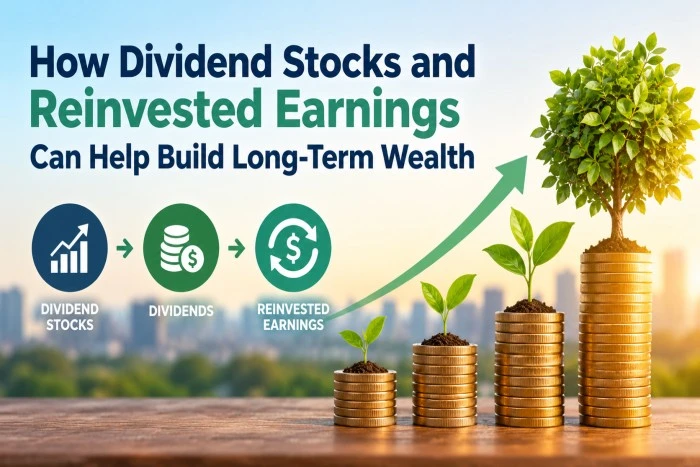
Receiving cash is only the first step. The real wealth-building engine starts when those payments are used to purchase additional shares. This process, known as dividend reinvestment, increases the number of shares owned without requiring new capital from the investor. Each new share then generates its own future payments, which in turn buy still more shares. The effect compounds powerfully. A portfolio that begins with a modest yield can see its income stream expand dramatically over 15 or 20 years simply through reinvestment, even if the underlying companies raise their payouts only modestly.
Consider a simplified illustration. An investor buys shares yielding 3 percent and reinvests every payment. Assuming the company grows earnings and raises the distribution at a steady 5 percent annually, the investor’s income and share count both rise at an accelerating rate. After two decades the annual income can exceed the original investment amount in many realistic scenarios. This outcome does not rely on aggressive speculation; it rests on patience and the mathematical force of compounding.
The Role of Quality and Consistency
Not every high-yielding security deserves a place in a long-term portfolio. Sustainable growth comes from businesses with durable competitive advantages, prudent capital allocation, and management teams committed to returning capital to owners. Guidance from research organizations such as fool can help investors identify such companies by emphasizing fundamental analysis over short-term price movements. Focusing on firms that have raised their distributions for 10, 15, or even 25 consecutive years often signals financial strength and shareholder-friendly policies.
Reinvestment works best inside tax-advantaged accounts when possible, because it avoids immediate taxation on the payments and allows the full amount to compound. Outside such accounts, investors must weigh the tax cost against the growth benefit, yet the long-term mathematics still frequently favor reinvestment for those with multi-decade horizons.
Combining Dividends with Broader Portfolio Construction
Dividend-focused strategies complement other wealth-building approaches. They can sit alongside growth-oriented holdings to create a balanced portfolio that generates income while retaining upside potential. Automatic reinvestment plans offered by many brokerages remove behavioral friction, ensuring payments flow back into the market without requiring constant decisions. Periodic review remains essential: investors should confirm that payout ratios stay reasonable, balance sheets remain healthy, and competitive positions endure.
Diversification across industries and geographies further strengthens the approach. Concentrating too heavily in a single sector exposes the portfolio to industry-specific risks, while spreading holdings reduces the impact of any one company’s difficulties. Over time, the combination of rising share counts and growing per-share distributions produces an expanding income base that can eventually support living expenses or fund other goals without the need to sell principal.

Realistic Expectations and Common Pitfalls
No strategy is risk-free. Share prices fluctuate, and even well-established companies can cut distributions during severe stress. Inflation can erode the purchasing power of fixed payments if companies fail to raise them sufficiently. Investors who chase the highest current yields often end up with deteriorating businesses whose high payouts prove unsustainable. A better filter emphasizes total return potential, payout safety, and growth prospects rather than yield alone.
Time remains the most critical ingredient. Compounding delivers its greatest benefits after many years. Investors who interrupt the process by spending the income early or selling during temporary declines forfeit much of the advantage. Maintaining discipline through market cycles separates those who merely collect payments from those who build meaningful wealth.
Putting the Strategy into Practice
Starting is straightforward. Identify a core group of high-quality companies with histories of reliable distributions. Enroll in a dividend reinvestment plan or set brokerage settings to reinvest automatically. Contribute additional capital regularly to accelerate share accumulation. Review holdings annually to confirm fundamentals remain intact, but avoid frequent trading that disrupts compounding. Over decades this methodical process has helped countless individuals convert ordinary savings into substantial portfolios capable of generating rising income streams.
The partnership between consistent distributions and reinvested earnings offers a clear, time-tested route to long-term wealth. By selecting resilient businesses, allowing payments to purchase more ownership, and giving the process years to work, investors position themselves to benefit from one of the market’s most reliable engines of growth. Patience and selectivity turn ordinary income into extraordinary results.