
Internal Revenue Service Guide: What Is a Roth IRA and Why Some Avoid It

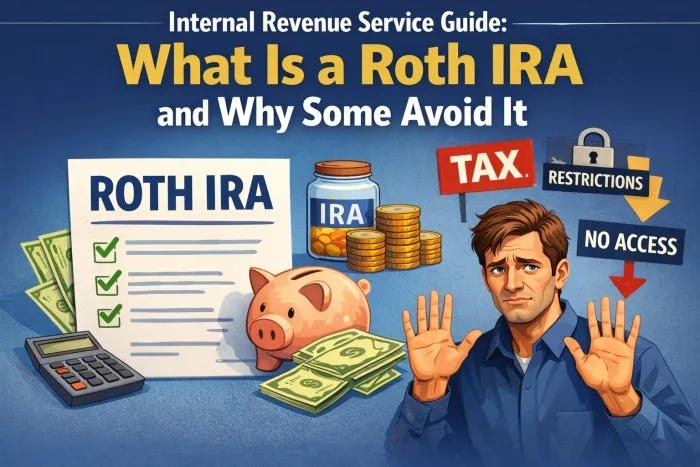
A Roth IRA is often praised as one of the most powerful retirement savings tools available — and financial sites like The Motley Fool regularly highlight its tax-free growth and flexibility as significant advantages. But like any financial strategy, it’s not ideal for everyone. Before opening one, it’s important to understand how it works — and in which situations it may not be the best choice.
Unlike traditional accounts, contributions are made with after-tax dollars, meaning you don’t get an upfront tax deduction. But that same feature can reduce your current saving power, and income limits or behavioral risks may make other retirement options more suitable for certain investors.
What Is a Roth IRA?
A Roth IRA (Individual Retirement Account) is a retirement account that allows you to contribute money after paying income taxes on it. In exchange, your investments grow tax-free, and qualified withdrawals in retirement are also tax-free.
Unlike a traditional IRA, you don’t get a tax deduction when you contribute. Instead, the benefit comes later.
Key features include:
- Contributions are made with after-tax dollars
- Earnings grow tax-free
- Qualified withdrawals are tax-free after age 59½
- No required minimum distributions (RMDs) during your lifetime
- Contribution limits are set annually by the Internal Revenue Service
For many savers, the idea of tax-free income in retirement sounds unbeatable. But there are trade-offs.
Why Some Investors Avoid a Roth IRA
While Roth IRAs can be powerful, they aren’t automatically the best option for every income level or life stage. Here are several reasons why some investors choose alternative strategies.
1. No Immediate Tax Deduction
With a traditional IRA or 401(k), contributions may reduce your taxable income today. That means you pay less in taxes this year.
With a Roth IRA, you give up that immediate tax break. If you’re in a high tax bracket right now, paying taxes upfront can be expensive.
For someone earning a strong income, lowering current tax liability might be more valuable than tax-free withdrawals decades later.
2. Income Limits Restrict Contributions
Roth IRAs have income limits. If your earnings exceed certain thresholds, your ability to contribute phases out.
This can complicate planning and may require backdoor Roth strategies, which add administrative complexity and potential tax consequences.
For higher earners, employer-sponsored retirement plans may offer a simpler solution.
3. You May Be in a Lower Tax Bracket Later
The main argument for a Roth IRA is that tax rates will be higher in retirement. But that’s not always the case.
Many retirees have:
- Lower living expenses
- Reduced taxable income
- Strategic withdrawal plans
If you expect to fall into a lower tax bracket later, paying taxes now through a Roth could mean paying more than necessary.
Traditional retirement accounts allow you to defer taxes until retirement, when rates might be lower.
4. Limited Contribution Caps
Roth IRA contribution limits are relatively low compared to workplace retirement plans.
If you’re trying to aggressively build wealth, the limited annual contribution may not be enough. For example, a 401(k) often allows significantly higher annual contributions, making it a more powerful wealth-building tool.
A Roth IRA can complement other accounts, but relying on it alone may limit growth potential.
5. Five-Year Rule Restrictions
Roth IRAs have a five-year rule for earnings withdrawals. Even if you’re over 59½, you must have held the account for at least five years before withdrawing earnings tax-free.
Early withdrawals of earnings can trigger taxes and penalties.
If you want flexibility or may need access to funds sooner, other accounts might offer fewer restrictions.
6. Opportunity Cost of Paying Taxes Now
Paying taxes upfront reduces the amount you can invest today.
For example:
- Contribute $6,000 after taxes to a Roth
- Or contribute pre-tax dollars to a traditional IRA and invest the tax savings
Depending on investment returns and tax strategy, deferring taxes may result in more money compounding over time.
When a Roth IRA Still Makes Sense
Despite these concerns, Roth IRAs can be beneficial if:
- You expect higher taxes in the future
- You’re early in your career and in a lower tax bracket
- You value tax-free income in retirement
- You want to avoid required minimum distributions
- You’re building tax diversification across accounts
The key is alignment with your long-term tax outlook and income trajectory.
Final Thoughts
A Roth IRA is not inherently good or bad — it’s a strategic tool. It offers tax-free growth and flexibility, but it requires paying taxes upfront and comes with income limits and contribution caps.
Before opening one, consider:
- Your current tax bracket
- Expected retirement income
- Access to employer retirement plans
- Long-term financial goals
Retirement planning isn’t about following trends. It’s about choosing the structure that fits your income, timeline, and tax expectations. For some investors, a Roth IRA is powerful. For others, alternative retirement accounts may provide stronger advantages.
The smartest move isn’t automatically choosing or avoiding a Roth IRA — it’s understanding how it fits into your overall financial strategy.