The Risks of After Hours Trading: Liquidity, Volatility and Wider Bid-Ask Spreads

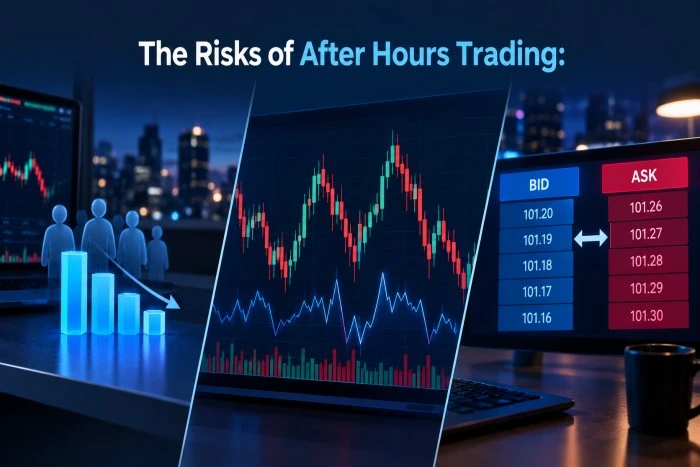
Regular market hours offer structure, depth, and relatively predictable pricing. Once the closing bell rings, that structure largely disappears. Investors who continue buying and selling stocks after hours trading face a very different environment—one marked by thinner order books, sudden price swings, and significantly wider bid-ask spreads. Understanding these risks is essential before placing any trade outside the normal session.
What Happens When the Market Closes
After the major U.S. exchanges close at 4:00 p.m. Eastern Time, trading does not stop completely. Electronic communication networks (ECNs) continue to match orders in the after-hours session, typically until 8:00 p.m. Participation, however, drops dramatically. Most institutional traders, market makers, and retail investors step away, leaving far fewer participants to provide continuous two-sided quotes. This reduced activity is the root cause of the three primary risks: liquidity shortages, elevated volatility, and expanded spreads.
Liquidity Dries Up Quickly
Liquidity refers to the ease with which an asset can be bought or sold without causing a large price movement. During regular hours, thousands of orders flow continuously, creating a deep and resilient order book. After hours, that depth collapses. A relatively modest market order can move the price several percentage points because there are simply fewer resting orders available to absorb it. Thin liquidity also means that limit orders may sit unfilled for extended periods, or fill only partially at unfavorable prices. For investors who need to exit a position quickly, this lack of depth can prove costly.
Volatility Spikes Without Warning
Lower participation amplifies the impact of any single trade or news event. Earnings releases, economic data, or geopolitical headlines often arrive after the close, and the market’s immediate reaction occurs in a sparsely populated trading venue. Without the stabilizing influence of large institutional flow, prices can gap sharply in either direction.
A stock that closed at $50 might trade at $47 or $53 within minutes, only to reverse once regular-hour trading resumes the next morning. These exaggerated moves create both opportunity and danger; for most retail traders the danger outweighs the opportunity.
Wider Bid-Ask Spreads Raise Transaction Costs
The bid-ask spread—the difference between the highest price a buyer is willing to pay and the lowest price a seller is willing to accept—widens considerably after hours. In regular trading a liquid large-cap stock might show a one- or two-cent spread. After hours that same stock can display spreads of ten, twenty, or even fifty cents. Every trade therefore incurs a higher implicit cost. Round-trip transactions (buying and later selling) can easily consume 1–2 percent of the position’s value solely through the spread, before commissions or slippage are considered. Over time these elevated costs erode returns.
How These Risks Interact
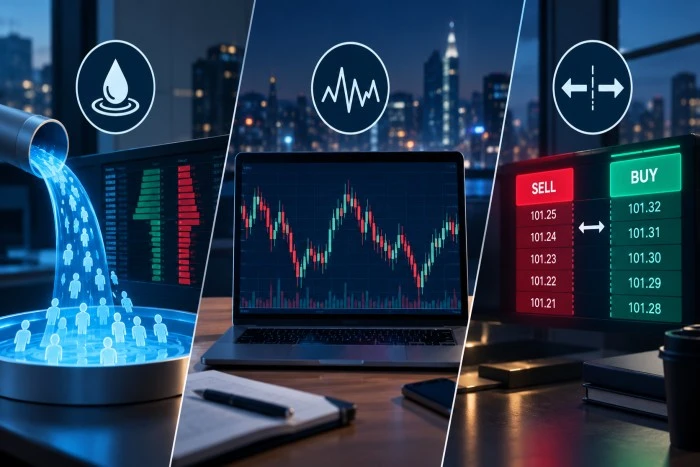
Liquidity, volatility, and spreads do not operate in isolation; they reinforce one another. Thin liquidity produces wider spreads, which in turn discourage additional participants, further reducing liquidity. News-driven volatility then hits this fragile structure, producing outsized price moves and even wider spreads. The result is a feedback loop that can trap traders in unfavorable positions. Many experienced investors therefore treat after-hours prices as temporary and incomplete signals rather than reliable valuations.
Practical Considerations for Investors
Before placing an after-hours order, confirm whether your broker supports the session and understand any additional fees. Prefer limit orders over market orders to avoid paying extreme prices in a thin book. Size positions conservatively; a small trade that would be invisible during regular hours can dominate the after-hours tape. Review upcoming catalysts—earnings dates, economic releases, or corporate announcements—so you are not surprised by sudden moves. Resources such as those published by fool can help investors evaluate whether the potential reward justifies the heightened risk.
When After-Hours Trading May Still Make Sense
Despite the drawbacks, certain situations warrant participation. Reacting promptly to material news, adjusting hedges, or managing large portfolios that cannot wait until the next open can justify the extra risk. Even then, the decision should rest on a clear assessment of liquidity conditions, expected volatility, and the cost of wider spreads. For the majority of individual investors, waiting for the regular session remains the more prudent course.
After-hours trading removes the protective layers that regular market hours provide. Reduced liquidity, amplified volatility, and expanded bid-ask spreads combine to create an environment where execution quality deteriorates and costs rise. Recognizing these structural realities allows investors to approach the extended session with realistic expectations and appropriate safeguards.