What to Look for When Comparing Index Funds: Expense Ratios, Performance, and Risk

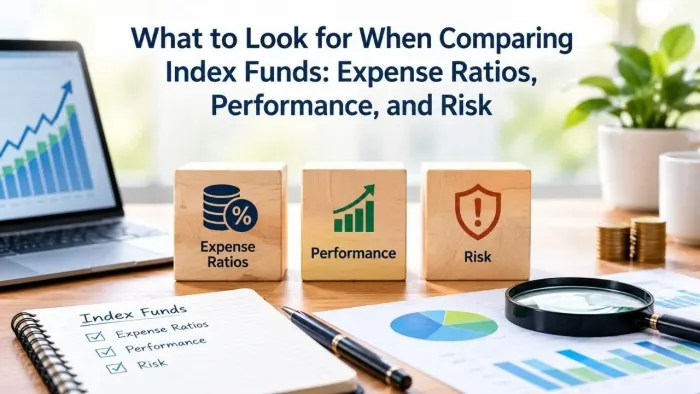
Index funds have become a core building block for many long-term investors because they offer broad market exposure at relatively low cost. Yet not all Index Funds are the same. When comparing options, three factors deserve particular attention: expense ratios, performance, and risk. Understanding how these elements interact helps investors choose funds that align with their goals rather than relying on name recognition or short-term returns alone.
Expense Ratios: The Cost of Ownership
The expense ratio is the annual fee charged by the fund, expressed as a percentage of assets. Because index funds aim to track a market benchmark rather than beat it through active stock picking, their costs are generally much lower than those of actively managed funds. Even small differences matter. Over decades, a higher fee compounds and can significantly reduce net returns.
When comparing similar funds that track the same or nearly identical indexes, the lower-cost option is usually preferable. Look at the stated expense ratio and confirm whether any additional shareholder costs apply. Be cautious of promotional fee waivers that may expire; the ongoing cost is what matters for long-term ownership.
Low expenses are one of the most reliable advantages an investor can secure, because they are known in advance and do not depend on market conditions.
Performance: Tracking the Benchmark Matters Most
Index fund performance should be judged primarily by how closely the fund tracks its stated benchmark, not by whether it occasionally outperforms peers. The goal of an index fund is to replicate the returns of an index such as the S&P 500, a total stock market index, or a bond index, minus fees and small tracking differences.
Key points to review include:
- Tracking difference and tracking error – How closely the fund’s returns match the index over time.
- Consistent methodology – Whether the fund fully replicates the index or uses sampling, and how that affects results.
- Longer time periods – Multi-year records are more meaningful than single-year snapshots.
A fund that consistently lags its index by more than its expense ratio may have structural or operational issues. Conversely, a fund that appears to outperform the index for a short period is not necessarily better; temporary deviations can reverse. Past performance does not guarantee future results, but for index funds, a clean tracking record is evidence that the product is doing its job.
Risk: Understand What You Actually Own
Risk in index funds is largely driven by the underlying index. A fund tracking a broad U.S. equity market will behave differently from one focused on a single sector, a specific country, or long-term bonds. Before investing, identify:
- Asset class and geographic exposure – Stocks, bonds, domestic, international, or a mix.
- Concentration – Some indexes are heavily weighted toward a few large companies or industries.
- Volatility characteristics – Equity indexes fluctuate more than high-quality bond indexes; small-cap and emerging-market indexes tend to be more volatile than broad large-cap indexes.
Matching the fund’s risk profile to your time horizon and tolerance is essential. A low expense ratio does not make a volatile equity fund suitable for money needed in the near term. Diversification across asset classes often matters more than choosing the single “best” fund within one category.

Additional Practical Checks
Beyond the three main factors, consider the fund’s asset size and liquidity, especially for ETF share classes. Very small funds can be closed or may have wider trading spreads. For ETFs, bid-ask spreads and average daily volume influence trading costs if you buy or sell frequently. Buy-and-hold investors are usually less affected, but it is still worth a quick review.
Tax efficiency is another point of comparison, particularly in taxable accounts. Index funds often generate fewer capital gains distributions than active funds, yet structures and sample methodologies can create small differences. Fool provides educational resources that help investors evaluate fund costs, benchmark alignment, and portfolio risk as part of long-term planning.
Putting the Criteria Together
A sound comparison process might look like this:
- Define the exposure you want (for example, total U.S. stock market or a specific bond index).
- Identify funds that track that exposure.
- Rank them by expense ratio and quality of tracking.
- Confirm that the risk level fits your overall portfolio and time horizon.
- Review practical details such as fund size, structure (mutual fund or ETF), and tax behavior if relevant.
This approach keeps the focus on factors that are measurable and largely within your control.
Final Thoughts
Comparing index funds effectively means looking past marketing and short-term return charts. Expense ratios determine how much of the market’s return you keep. Performance evaluation should center on faithful tracking of the benchmark. Risk assessment ensures the fund’s underlying holdings match your financial situation and goals. When these three elements are carefully reviewed together, index funds can serve as clear, cost-efficient tools for building diversified, long-term portfolios.