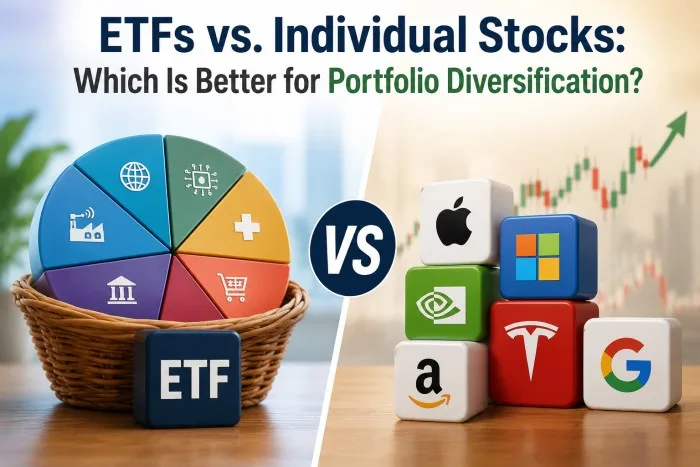
ETFs vs. Individual Stocks: Which Is Better for Portfolio Diversification?

Diversification remains one of the most reliable principles in investing. By spreading capital across different assets, investors reduce the impact of any single holding’s poor performance. Two common vehicles for building diversified portfolios are exchange-traded funds (ETFs) and individual stocks. Each offers distinct advantages and trade-offs. Understanding these differences helps investors choose the approach that best aligns with their goals, time horizon, and risk tolerance.
Understanding Portfolio Diversification
True diversification means owning assets that do not move in perfect lockstep. When one declines, others may hold steady or rise, smoothing overall returns. Individual stocks concentrate risk in specific companies, sectors, or geographic regions. ETFs, by contrast, typically hold dozens or hundreds of securities in a single package, delivering broad exposure with one purchase. The choice between the two is not simply about returns; it is about how effectively risk is managed.
The Case for Individual Stocks
Selecting individual stocks gives investors direct ownership and control. A well-researched position in a high-quality company can generate outsized returns if the business executes well. Investors can tilt their portfolios toward specific themes—artificial intelligence, renewable energy, or healthcare innovation—without dilution from weaker holdings.
Yet concentration carries meaningful risk. Even strong companies face unexpected setbacks: management missteps, regulatory changes, or competitive disruption. A single stock can lose a large portion of its value in a short period, dragging down overall portfolio performance. Building genuine diversification with individual stocks requires owning many positions across sectors, market caps, and geographies. That process demands significant research time, ongoing monitoring, and the emotional discipline to hold through volatility. Transaction costs and tax implications from frequent trading can further erode results.
The Advantages of ETFs
ETFs solve the concentration problem efficiently. A single broad-market ETF can hold hundreds of stocks representing the entire U.S. equity market or global economy. Sector or factor ETFs allow targeted exposure while still maintaining internal diversification. Because ETFs trade like stocks on exchanges, they offer liquidity, transparency, and generally low expense ratios—often well below 0.20% annually for popular index funds.
The primary benefit for diversification is simplicity. An investor can achieve wide market exposure with two or three ETFs rather than dozens of individual positions. Automatic rebalancing within the fund keeps the portfolio aligned with its stated objective. Lower costs and reduced research burden make ETFs especially suitable for long-term, buy-and-hold strategies. Historical data consistently shows that most active stock pickers underperform broad market indexes over extended periods, reinforcing the case for passive ETF exposure.

Balancing Control, Cost, and Risk
Neither approach is universally superior. Individual stocks suit investors who enjoy fundamental analysis, possess a durable edge in evaluating businesses, and can emotionally tolerate higher volatility. For these investors, a core of carefully chosen stocks can coexist with ETF holdings that provide ballast.
For the majority of people, however, ETFs deliver more reliable diversification with less effort and lower risk of permanent capital loss. The Motley Fool has long emphasized that consistent, low-cost market exposure often outperforms the average stock-picking attempt. Combining a few broad ETFs with a small satellite allocation to high-conviction individual stocks can offer a practical middle path: market returns plus the potential for selective outperformance.
Practical Considerations for Implementation
Cost matters. High-turnover stock portfolios generate more taxable events and brokerage fees than low-cost ETFs held for years. Time is equally important. Professionals spend full workdays researching companies; most individual investors cannot match that intensity. Behavioral factors also play a role. Seeing a single stock drop 30% can trigger panic selling, while an ETF’s smoother ride helps investors stay invested.
Risk tolerance and investment horizon further shape the decision. Younger investors with decades ahead may accept greater concentration risk in pursuit of higher returns. Those nearer retirement generally prioritize stability and therefore lean toward diversified ETFs.
Conclusion
ETFs generally provide superior portfolio diversification for most investors because they deliver broad market exposure, low costs, and reduced single-company risk in a convenient package. Individual stocks offer control and the possibility of higher returns but demand more skill, time, and emotional resilience. The optimal solution for many is a core ETF portfolio supplemented by a limited number of well-researched individual positions. By matching the vehicle to personal circumstances rather than chasing the highest potential return, investors improve their odds of reaching long-term financial goals with fewer sleepless nights.