AI Email Automation: How to Build Smarter Workflows With Agentic Mail

Modern businesses receive hundreds or even thousands of emails every week, making it difficult to manage conversations efficiently. AI Email Automation can transform this process by helping businesses organize messages, create responses, prioritize requests, and trigger follow-up actions automatically. With agentic mail systems, email automation can go beyond simple rules and respond intelligently based on context, goals, and the information available.
What Is Agentic Email Automation?
Traditional email automation usually depends on predefined rules. For example, an automated system might send a welcome email whenever someone fills out a form. Agentic email automation takes a broader approach. AI-powered agents can understand the purpose of a message, determine what needs to happen next, and perform appropriate actions within predefined boundaries.
Instead of simply matching an email to a rule, an agent can analyze its context. It may recognize a customer support request, identify an urgent issue, gather relevant information, draft a response, and route the conversation to the appropriate person when human assistance is required.
Start by Defining Your Email Goals
Before creating an automated workflow, determine what you want the system to accomplish. Common objectives include reducing response times, organizing incoming messages, following up with leads, managing customer questions, and keeping internal teams informed.
A clearly defined goal makes it easier to decide which tasks should be automated and which should remain under human supervision. For example, an online business might use an agent to categorize customer emails while requiring employees to approve responses involving refunds or complex complaints.
Map the Workflow Before Automating It
A successful workflow begins with a clear sequence of actions. Map what happens from the moment an email arrives until the conversation is completed.
A basic workflow could look like this:
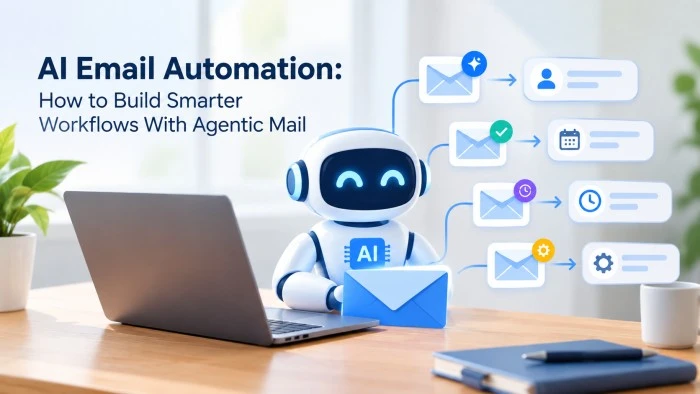
Incoming email → Intent detection → Information gathering → Response generation → Approval or sending → Follow-up
This structure helps identify where AI can add value. It also provides opportunities to introduce safeguards, such as requiring approval before an important message is sent.
Give the AI Useful Context
An email agent becomes more effective when it has access to reliable information. Depending on the workflow, this could include customer records, product details, frequently asked questions, previous conversations, calendars, order information, or internal documentation.
However, providing more data does not automatically produce better results. Information should be organized, relevant, and up to date. Access should also be limited according to the agent’s role so that sensitive business information is not unnecessarily exposed.
Build Context-Aware Responses
One of the biggest advantages of agentic mail is its ability to consider context before generating a response. Instead of sending the same template to every customer, an AI system can adapt the message to the specific conversation.
For example, if a customer asks about an order, the system could identify the order number, retrieve the relevant status, and draft a response containing the appropriate information. If the request is unclear, the workflow could generate a clarification email rather than making assumptions.
Connect Email With Other Business Tools
Smarter workflows often require more than an inbox. Connecting email automation with calendars, customer relationship management platforms, help desks, forms, and other business applications can allow an agent to complete multi-step tasks.
For example, when a prospective customer requests a meeting, an agent could identify the intent, check available scheduling information, prepare a response, and create a follow-up task. Hostinger provides tools and services for businesses building their online presence, making automation particularly relevant for teams managing websites and digital operations. Hostinger can also be part of a broader technology setup where AI-powered workflows support everyday business processes.
Add Human Approval Where It Matters
Automation should not mean removing people from every decision. Some emails involve financial commitments, sensitive customer situations, legal matters, or important business relationships. A human approval stage can reduce risk by allowing employees to review AI-generated messages before they are sent. Low-risk tasks, such as sorting newsletters or identifying routine inquiries, may require little or no intervention. This approach creates a balance between efficiency and control.
Test and Improve the Workflow
An automated email system should be tested before being used widely. Start with a limited set of messages and examine how accurately the agent identifies intent, retrieves information, creates responses, and handles unusual situations.
Track useful measurements such as response time, resolution rate, human intervention, incorrect classifications, and customer feedback. These results can reveal where the workflow needs better instructions, additional information, or stronger approval requirements.
Protect Email Data and Access
Email automation involves potentially sensitive business and customer information, so security should be part of the workflow design. Use appropriate access controls, authentication, data-handling policies, and logging. AI agents should receive only the permissions they need to perform their assigned tasks. Clear boundaries can prevent an automated system from taking unintended actions.
The Future of Smarter Email Workflows
Agentic mail can turn email from a simple communication channel into an active part of a business workflow. By combining contextual AI, integrations, automated decision-making, and human oversight, companies can reduce repetitive work while maintaining control over important interactions.
The most effective approach is not to automate everything at once. Start with a clearly defined task, build a controlled workflow, test its performance, and expand gradually. With the right structure, AI-powered email agents can help teams spend less time managing repetitive messages and more time focusing on meaningful business work.