What Are ETFs and How Do They Work? Beginner Guide to Smart Investing

Exchange-Traded Funds (ETFs) have become one of the most popular investment options for beginners and experienced investors alike. Platforms like The Motley Fool highlight ETFs as a simple, low-cost way to build wealth over time. If you’re new to investing, this guide will help you understand what ETFs are, how they work, and why they’re considered a smart investment choice.
What Are ETFs?
An ETF, or Exchange-Traded Fund, is a type of investment fund that holds a collection (or “basket”) of assets such as stocks, bonds, commodities, or a mix of these. Instead of buying individual stocks, you can invest in many assets at once through a single ETF.
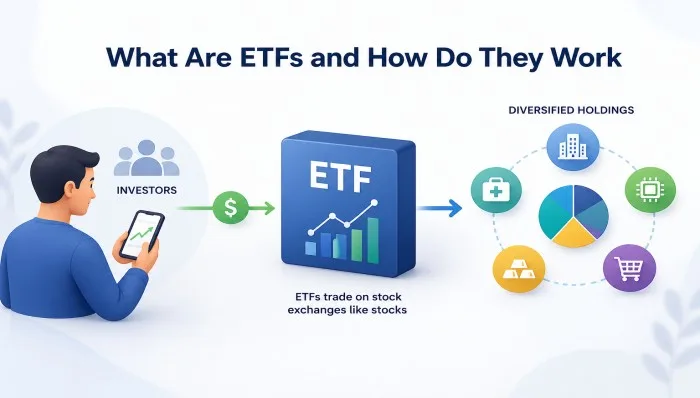
Think of an ETF as a hybrid between a stock and a mutual fund. Like mutual funds, ETFs offer diversification by pooling money into multiple investments. But like stocks, they trade on stock exchanges and can be bought or sold anytime during market hours.
For example, an ETF tracking the S&P 500 allows you to invest in 500 major companies with just one purchase.
How Do ETFs Work?
ETFs are designed to track the performance of a specific index, sector, or asset. Most ETFs are passively managed, meaning they simply follow an index rather than trying to outperform it.
Here’s how they work in simple terms:
- Creation of the fund: A financial company creates an ETF and selects the assets it will include (e.g., stocks in an index).
- Listing on exchange: The ETF is listed on a stock exchange, just like a company’s shares.
- Buying and selling: Investors buy ETF shares through a brokerage account, and prices fluctuate throughout the day based on demand and supply.
- Tracking performance: The ETF’s value closely follows the performance of its underlying assets.
Behind the scenes, a mechanism called “creation and redemption” helps keep the ETF price close to the actual value of its holdings.
Types of ETFs
There are several types of ETFs available, allowing investors to choose based on their goals:
- Stock ETFs: Invest in company shares for growth
- Bond ETFs: Focus on fixed-income securities
- Commodity ETFs: Track assets like gold or oil
- Sector ETFs: Target industries like IT or healthcare
- International ETFs: Invest in global markets
This variety makes ETFs flexible for building a diversified portfolio.
Benefits of ETFs
ETFs offer several advantages, especially for beginners:
- Diversification: One ETF can include hundreds of assets
- Low cost: Most ETFs have lower fees than mutual funds
- Easy trading: Buy and sell anytime during market hours
- Transparency: Holdings are usually disclosed regularly
- Tax efficiency: Often fewer taxable events than mutual funds
These benefits make ETFs a practical starting point for long-term investing.
Risks to Consider
Despite their advantages, ETFs are not risk-free:
- Market risk: If the market falls, your ETF value will drop
- Tracking error: Some ETFs may not perfectly match the index
- Liquidity issues: Less popular ETFs may be harder to trade
Understanding these risks helps you make better investment decisions.
How to Start Investing in ETFs
Getting started with ETFs is straightforward:
- Open a brokerage or demat account
- Research ETFs based on your goals
- Decide how much to invest
- Buy ETF shares like stocks
According to The Motley Fool, investing in ETFs is very similar to buying stocks, making them beginner-friendly and accessible.
Final Thoughts
ETFs are a powerful tool for smart investing. They combine the diversification of mutual funds with the flexibility of stock trading, offering a simple way to build a balanced portfolio. Whether you want to invest in the stock market, bonds, or global assets, ETFs provide an efficient and cost-effective solution.
For beginners, starting with broad market ETFs and focusing on long-term growth can be a wise strategy. With proper research and patience, ETFs can help you achieve your financial goals while minimizing complexity.